
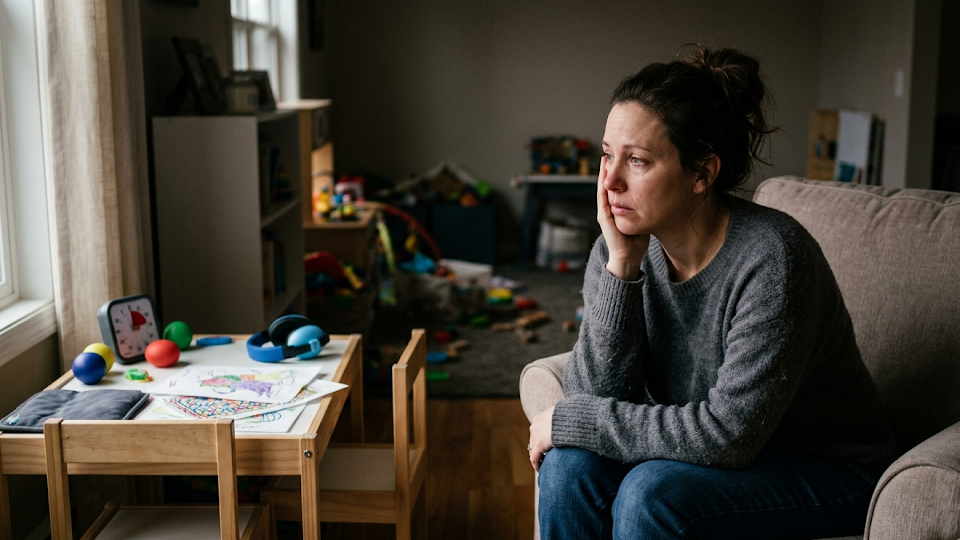
There is something many parents of neurodivergent children experience but rarely say out loud.
It’s called grieving the gap.
If you’ve never heard that phrase before, you still might know exactly what it feels like.
It’s the ache that shows up when your child’s life doesn’t look the way you once imagined it would. It’s watching other families move through milestones that seem effortless while your family is working twice as hard just to make it through an ordinary day. It’s sitting in school meetings, worrying about your child’s mental health, wondering how they really feel inside, and trying to hold together your own fear while also being their safe place.
And I want to say this first, because I know how heavy this topic can feel:
Grieving the gap does not mean you love your child any less.
It does not mean you wish for a different child.
It does not mean you aren’t grateful.
It does not mean you are failing.
It means you are carrying a kind of grief that is hard to explain to people who have never lived it.

What Does “Grieving the Gap” Mean in Neurodivergent Parenting?
Grieving the gap is the emotional process of reconciling two very different realities:
- the childhood you thought your child would have
- and the childhood they are actually living
For parents of neurodivergent kids, the gap can feel enormous.
You may have imagined:
- easy school years
- friendships that formed naturally
- birthday parties without worry
- sports without emotional fallout
- holidays that felt joyful instead of overwhelming
- a child who moved through school in a way the system easily understood
Instead, you may find yourself navigating:
- anxiety
- sensory overload
- meltdowns
- school avoidance
- emotional regulation struggles
- constant parent-teacher communication
- evaluations, IEPs, and advocacy
- the fear that your child feels “less than” in a world that isn’t built for them
The grief is not about your child.
The grief is about the loss of the easier path you thought they would get to walk.
And sometimes, if I’m being honest, the grief is also about watching your child work so much harder than everyone around them just to do things other kids seem to do without even thinking.
If your child struggles with the intense emotional overwhelm that often comes with neurodivergence, you may also relate to the difference between a true meltdown and a tantrum. I wrote more about that here: Meltdowns vs. Tantrums: What Parents of Neurodivergent Kids Need to Know.
The Guilt That Comes With Grieving the Gap
One of the hardest parts of grieving the gap is the guilt.
Because as parents, we can start asking ourselves questions like:
- Does feeling sad about this make me a bad parent?
- Does this mean I wish my child were different?
- Am I focusing too much on what’s hard?
- Why can’t I just be grateful?
But grief and love can exist at the same time.
You can love your child with your whole heart and still mourn how hard life is for them.
You can deeply value who they are and still feel crushed by the reality that the world doesn’t always know how to support them.
You can be incredibly proud of your child and still feel grief over the things they have to carry that other children don’t.
That doesn’t make you disloyal to your child.
It makes you honest.
My Own Experience With Grieving the Gap
For me, grieving the gap wasn’t one dramatic moment.
It happened slowly.
It happened in layers.
My son has always been incredibly intelligent. Even as a young child, he would say things that felt far beyond his years. He is funny, insightful, deeply thoughtful, and the kind of kid who notices everything.
But he has also struggled in ways many people can’t see.
At four years old, he told me he felt different from other kids.
Think about that for a second.
Four years old.
While other children were simply moving through life, my son was already aware that something felt different inside him. He didn’t have the words for all of it yet, but he knew. And as his mom, there is nothing that can prepare you for hearing that from your child so young.
As the years went on, there were school struggles, emotional regulation challenges, anxiety, and moments where I found myself lying awake wondering what he was carrying internally that I couldn’t fully see.
There is a fear that comes with parenting a child who struggles emotionally that is hard to explain to anyone who hasn’t lived it.
I check on him at night.
I think about how the school day felt for him.
I worry about whether he feels “less than” inside.
I worry about how much effort it takes him just to hold it together in a world that was not built for his brain.
And somewhere along the way, I realized I wasn’t just grieving the hard moments.
I was grieving the gap between the childhood I imagined for him and the reality of how hard he has had to fight just to get through ordinary days.

The School Gap: When School Is Not Built for Your Child’s Brain
School is one of the places where grieving the gap can feel the loudest.
You watch other families celebrate report cards, school awards, class behavior charts, and academic milestones.
Meanwhile, your child may be using every ounce of energy they have just to make it through the day.
Some children are being praised for thriving inside the system.
Other children are simply trying to survive it.
That doesn’t mean one child is trying harder than the other.
It means the system was built to reward certain kinds of brains more easily than others.
For neurodivergent kids, school can require constant self-monitoring, masking, sensory endurance, frustration tolerance, and emotional recovery. By the time they get home, they may have nothing left.
And as parents, we see that.
We see the effort no one else sees.
We see the kid who held it together all day and then falls apart at home because home is the only place they feel safe enough to unravel.
We see the child who looks “fine” at school but comes home completely dysregulated.
We see the child who isn’t getting the awards but is quietly climbing a mountain every single day.
If your child seems to completely unravel as the school year drags on, you may also relate to this post I wrote about why neurodivergent kids struggle at the end of the school year. Sometimes school burnout doesn’t look dramatic from the outside, but inside our homes, we feel every bit of it.
The Silent Pain of School Awards and “Visible Success”
There is a kind of pain here that I think many parents carry silently.
Sometimes it happens in a school assembly, an end-of-year classroom celebration, or a student of the month ceremony.
One child gets called up for an award.
Maybe they earned student of the month.
Maybe they got recognized for academics, leadership, attendance, or behavior.
And if you have more than one child, you may know exactly how complicated this moment can feel.
Because maybe one of your children thrives in that system.
And another child—equally extraordinary in their own way—will probably never be student of the month.
Not because they aren’t intelligent.
Not because they aren’t worthy.
Not because they don’t have incredible gifts.
But because school rewards a very specific kind of success.
And some children are using all of their energy just to get through the day.
I have one child who gets school awards and another who likely never will. And that is a very specific kind of grief to hold as a parent. Not because one child is more deserving than the other, but because it makes the difference between their school experiences feel so visible. One child is being celebrated by the system, while the other is simply trying to survive it.
I know my son is extraordinary. I don’t need a school award to tell me that.
But I also think some people don’t realize how much more apparent those moments can make the gap feel—for parents and for kids. Awards can shine a spotlight on the kind of success that school recognizes, while making it painfully obvious which children are struggling inside that same environment.
And for some of our kids, the real accomplishment isn’t a certificate.
It’s that they made it through the school day at all. That they handled the sensory overload of the cafeteria. That they kept themselves from exploding when they were overwhelmed.
It’s that they showed up to a place that asks them to function in ways that don’t come naturally to their brains.
That effort is real.
That resilience is real.
That strength matters.
But it is often invisible.
This is one of the quiet griefs of neurodivergent parenting: watching the world celebrate visible success while your child’s invisible effort goes unseen.
And if you’ve ever sat there clapping for other children while privately grieving for your own, I want you to know that you are not alone.
Not because you aren’t happy for someone else’s child.
Not because you don’t love your own child exactly as they are.
But because it hurts to watch your child struggle inside a system that was never truly built for them.
The Social Gap: The Isolation That Comes With Parenting a Neurodivergent Child
The gap also shows up socially.
Maybe your child struggles to make friends.
Maybe birthday parties are overwhelming.
Maybe family outings require so much planning that they don’t feel worth it anymore.
Maybe you’ve left events early, skipped gatherings altogether, or spent entire outings in a state of hypervigilance waiting for things to fall apart.

Sometimes the grief isn’t just about what your child is missing.
It’s about what you are missing too.
The parenting community you thought you’d have.
The ease you thought family life would hold.
The simple social moments that don’t feel simple at all when your child is dysregulated, anxious, sensory overloaded, or misunderstood.
It can feel incredibly isolating.
And it’s one of the reasons so many parents of neurodivergent children feel emotionally exhausted and unseen.
If you’re in a season where your child’s nervous system feels constantly overwhelmed, some of the things that helped us most are in my post on the best calming tools for neurodivergent kids and my full guide to calm-down kit essentials for home and school.
The Future Gap: Grieving the Loss of a Predictable Roadmap
One of the hardest parts of grieving the gap is the future.
As parents, we naturally picture our children growing up. We imagine friendships, school milestones, sports, independence, confidence, and happiness. We imagine things becoming easier with time.
When your child is neurodivergent, the future can feel much less predictable.
You may find yourself asking questions like:
- Will they feel okay inside?
- Will they have true friends?
- Will school always feel this hard?
- Will they ever feel confident in who they are?
- Will the world understand them?
- Will they find environments that work with their brain instead of against it?
That uncertainty is exhausting.
And if you are parenting a child with anxiety, emotional regulation challenges, OCD tendencies, sensory struggles, or school-based trauma, the future can feel especially heavy.
Sometimes grieving the gap is grieving the loss of certainty.
The loss of a roadmap.
The loss of believing you know what comes next.
What Helped Me Start Moving Through the Grief
I don’t think grieving the gap is something you fully “solve.”
I think it’s something you move in and out of as your child grows, as new struggles emerge, and as your own understanding deepens.
But there are a few things that have helped me.
1. Accepting That Love and Grief Can Exist at the Same Time
This was a huge one for me.
I had to stop seeing grief as a betrayal of my child.
Grief doesn’t mean I wish my son were someone else.
It means I wish life were easier for him.
It means I wish the world understood him better.
It means I wish school didn’t ask him to fit into a mold that doesn’t match how his brain works.
It means I wish he didn’t have to fight so hard just to feel okay.
That is not rejection.
That is love.
2. Redefining What Success Looks Like
Neurodivergent parenting has forced me to completely redefine success.
Success is not always an award, a grade, or a public milestone.
Sometimes success looks like:
- getting through the school day without shutting down
- asking for help instead of melting down
- recovering more quickly after a hard moment
- making it into the building on a difficult morning
- advocating for what they need
- learning one new coping skill
- feeling safe enough to be fully themselves at home
Those are not small things.
They are huge things.
And our kids deserve to have those victories honored too.
If you’re looking for practical tools to support regulation at home or school, I put together two posts that may help: Best Calming Tools for Neurodivergent Kids and Calm-Down Kit Essentials for Home and School That Actually Help.
3. Focusing on Micro-Milestones Instead of Traditional Milestones
When you parent a neurodivergent child, you learn to notice progress that other people miss.
The first time your child uses a coping strategy on their own.
The first school event they make it through.
The first time they tell you how they’re feeling instead of exploding.
The first time they recover more quickly after being overwhelmed.
Those moments matter.
In many families like ours, growth is not linear and progress is not always visible from the outside.
But it is still progress.
And sometimes those micro-milestones matter more than any public recognition ever could.
4. Letting Grief Turn Into Advocacy
One of the things grieving the gap has done for me is turn me into a stronger advocate.
When you realize how often your child is being misunderstood, overlooked, or measured against standards that don’t reflect their actual effort, it changes you.
You stop assuming the system will naturally do right by them.
You start asking harder questions.
You start paying closer attention.
You start learning the language of accommodations, supports, and school advocacy because you know your child needs someone who sees the whole picture.
If you’re in that season right now, I wrote more about it here: Becoming an Advocate for Your Neurodivergent Child.
5. Finding Resources That Help You Feel Less Alone
Sometimes what helps most is simply hearing, “me too.”
The right book, the right article, the right parent story, the right coping tool, or the right late-night Google search can make you feel less isolated in this experience.
That is one of the reasons I created this site in the first place.
Because I know how lonely this kind of parenting can feel.
And I know how powerful it is when someone finally puts words to the things you’ve been carrying quietly.
If that’s where you are right now, you might also want to read Parenting a Neurodivergent Child: What I Wish I Knew First and 7 Books That Changed How I Parent My Neurodivergent Child. Both are the kinds of posts I wish I had when I was trying to make sense of what our family was living.
Books That Helped Me Feel Less Alone
If you’re in a season of grieving the gap, these are the kinds of books that can help you feel understood, grounded, and less alone as a parent:
- The Explosive Child by Ross Greene
- Uniquely Human by Barry Prizant
- Self-Reg by Stuart Shanker
You can also read my full list here: 7 Books That Changed How I Parent My Neurodivergent Child.
If your child also struggles with anxiety, I also put together a list of books for kids with anxiety that may help start some really important conversations.
The Nighttime Side of Grieving the Gap
I also think grieving the gap gets heavier at night.
During the day, there’s so much to do—school, work, logistics, appointments, behaviors, coping, getting through the next thing.
But at night, when everything is quiet, the worry gets louder.
That’s when I’ve often found myself checking on my son, replaying the day, wondering how much he’s holding inside, wondering if he feels okay, wondering if he knows how extraordinary he is even when the world doesn’t always reflect that back to him.
And for many of us, sleep becomes part of the story too.
Because neurodivergent kids often don’t just struggle during the day—they struggle at bedtime, with transitions, with anxiety, with winding down, with feeling safe enough to rest.
If sleep is part of your family’s struggle too, you may want to read What Actually Helped My Neurodivergent Child Sleep, Why Neurodivergent Kids Have Sleep Problems, and Sleep Issues in Children: What Parents Need to Know. Sleep struggles can magnify everything, both for our kids and for us.
What Grieving the Gap Has Taught Me
Grieving the gap has changed me.
It has made me more compassionate.
It has made me a stronger advocate.
It has forced me to challenge what success really means.
It has taught me to see resilience in places the world often overlooks.
Most of all, it has taught me that a different path is not a lesser one.
My son may not move through life in the way the world expected.
He may never be the child who fits neatly into the systems designed for easier, quieter, more compliant brains.
But he is extraordinary.
He is insightful, funny, resilient, and deeply himself.
And while this journey has looked nothing like I imagined, I would never trade who he is.
What I want—what I grieve, what I fight for, what I think about in the quiet hours—is not a different child.
It is a different world for the child I already have.
A world that understands him better.
A world that makes more room for brains like his.
A world that does not confuse struggle with lack of worth.
This Isn’t About Wanting a Different Child
I think this part matters enough to say clearly.
Grieving the gap is not about wanting a different child.
It’s not about wishing away your child’s personality, strengths, intensity, sensitivity, humor, brilliance, or the very things that make them them.
It’s about grieving the pain.
The misunderstandings.
The loneliness.
The anxiety.
The school struggles.
The way the world can make them feel like too much or not enough all at once.
If I could take away the things that hurt my child without changing who he is, I would do it in a heartbeat.
That is the heart of this grief.
Not rejection.
Protection.
Not disappointment in who your child is.
Heartbreak over how hard the world can be on children who don’t fit neatly into it.
If You Are Grieving the Gap Right Now
If you are reading this because you feel the ache of neurodivergent parenting deep in your bones, I want you to hear this:
You are not a bad parent for feeling grief.
You are not weak for struggling with the reality of how hard this can be.
You are not ungrateful for mourning the path you thought your child would have.
And you are absolutely not alone.
Grieving the gap is not about loving your child less.
It is about loving them so much that it hurts to watch them navigate a world that doesn’t know what to do with them.
And if that’s where you are right now, I hope this post reminds you of something important:
Your child’s worth is not measured by awards.
It is not measured by behavior charts.
It is not measured by how easily they fit into school, sports, or social expectations.
And neither is yours.
Sometimes the bravest, most extraordinary thing our children do is simply keep showing up in a world that makes everything harder than it should be.
And sometimes the bravest thing we do as parents is keep showing up right beside them.

Related Posts for Parents of Neurodivergent Kids
If this post resonated with you, here are a few other articles on NeurodivergentKid.com that may help:
- Meltdowns vs. Tantrums: What Parents of Neurodivergent Kids Need to Know
- Parenting a Neurodivergent Child: What I Wish I Knew First
- Becoming an Advocate for Your Neurodivergent Child
- Best Calming Tools for Neurodivergent Kids
- Calm-Down Kit Essentials for Home and School That Actually Help
- What Actually Helped My Neurodivergent Child Sleep
- 7 Books That Changed How I Parent My Neurodivergent Child
Free Resource for Overwhelmed Parents
If your child struggles with emotional regulation, meltdowns, overwhelm, or sensory stress, I created a free resource to help.
Download the Free Calm & Regulation Toolkit for practical tools you can use at home.
Disclaimer: This post is based on my personal experience parenting a neurodivergent child and is intended for informational and supportive purposes only. It is not medical, mental health, educational, or legal advice.