
✏️ Starting a new school year is exciting.
Fresh notebooks, sharpened pencils, new backpacks, and the feeling of a fresh start fill store aisles every August. For many families, it’s a mix of nervous energy and anticipation as the first day gets closer.
Whether your child has ADHD, anxiety, sensory processing challenges, or other neurodivergent traits, the first day of school can bring excitement and uncertainty for the whole family.
It’s not just excitement.
It’s a layered anxiety that sits underneath everything else.
It’s wondering if this will be the year your child feels understood.
It’s hoping they’ll have a teacher who sees their strengths instead of only their struggles.
It’s quietly worrying about whether they’ll make it through the school day without becoming overwhelmed, shutting down, or melting down from sensory overload, social pressure, or exhaustion from masking all day.
And your child is carrying their own version of that anxiety too.
They might be excited to see friends again, but also quietly worried about what the school day will feel like.
They may talk about being ready for a new year while also remembering how hard last year felt in their body.
I know that feeling deeply.
Every August, I used to tell myself this would be the year things felt easier. That this time, we’d finally have a smoother transition. Some years have been better than others, but what I’ve learned is this:
I can’t control everything that happens once my child walks into school—but I can help them feel more grounded before they get there.
And over time, I realized something important:
The most helpful things in my child’s backpack were never actually on the school supply list.
Yes, pencils and folders matter.
But so do the small, invisible supports that help a child regulate emotions, manage anxiety, and feel safe in an environment that can sometimes feel overwhelming.
This post is a collection of the backpack essentials that have helped our family through school transitions—and I hope they help yours too.
️*Affiliate Disclosure
This post may contain affiliate links, which means I may earn a small commission at no extra cost to you. I only recommend products I truly believe will help support you and your child.
As an Amazon Associate, I earn from qualifying purchases. I may also earn from other affiliate programs.
🧠 Why Backpack Preparation Matters More Than School Supplies
For neurodivergent kids, school isn’t just an academic environment—it’s a sensory, emotional, and social environment all happening at once.
Many parents search for the best school supplies for children with sensory needs, but what I’ve learned is that emotional support is just as important as notebooks and folders. The right backpack essentials can help children feel more regulated, confident, and prepared throughout the school day.
That means a backpack isn’t just for carrying schoolwork.
It becomes a regulation toolkit for the day.
A small item can sometimes prevent a large emotional spiral.
A familiar object can provide grounding in an unfamiliar moment.
A quiet tool can make a loud environment feel manageable.
And for parents, preparing that backpack isn’t just about organization—it’s about emotional preparation too.
Because we’re not just preparing for spelling tests and math worksheets.
We’re preparing for transitions, sensory overload, social stress, unexpected changes, and all the invisible demands that come with school.
🧩 Real Parent Moment
There were mornings when everything looked fine on the outside.
Backpack packed. Shoes on. Lunch made.
And still, I’d sit in the car after drop-off and feel that quiet uncertainty settle in.
Did I prepare him enough for today?
Will today be overwhelming?
Will he feel safe asking for help?
That kind of worry is hard to explain to people who haven’t lived it.
Because it’s not about fear of failure—it’s about wanting your child to feel okay in a world that often feels like too much.
🎒 What This Post Will Cover
In this post, you’ll find:
- 15 backpack essentials that support emotional regulation, sensory needs, and anxiety
- Simple tools that can make the school day easier
- Practical ideas you can actually implement (not overwhelming “perfect parenting” lists)
- Gentle ways to communicate with teachers about supports
- And real-life context from lived experience, not just theory
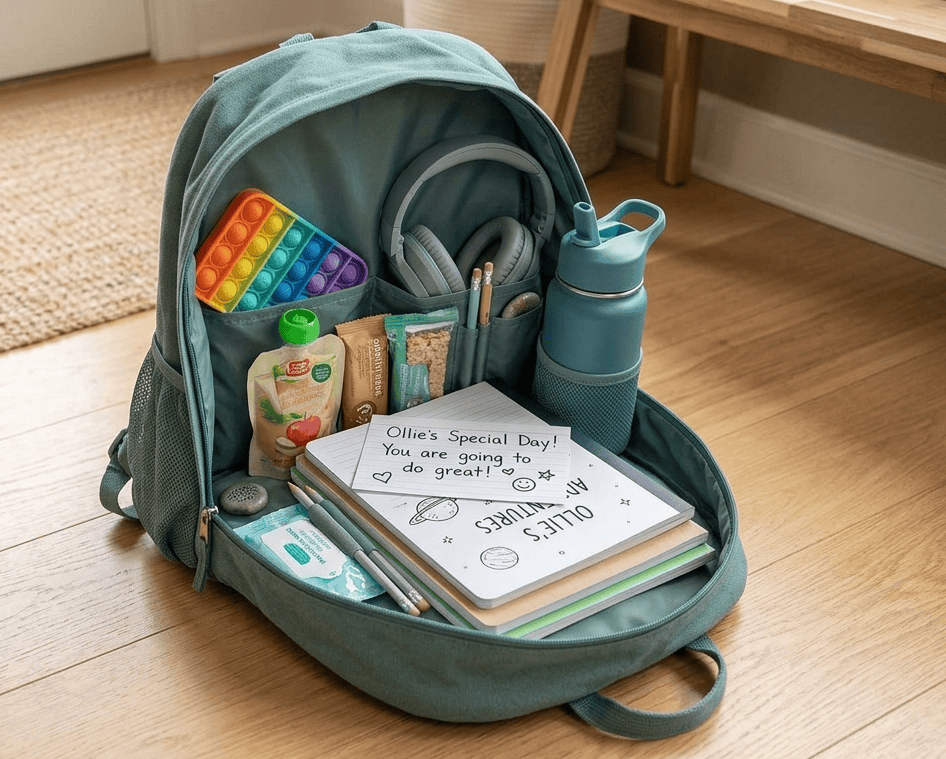
⭐ My Neurodivergent Kid Backpack Regulation Kit
Inside:
✅ discreet fidget
✅ fidget pencil
✅ worry stone
✅ headphones
✅ preferred water bottle
✅ snack
✅ visual reminder card
✅ small comfort item
🎒 1. Quiet Fidgets for Focus and Anxiety
One of the most common questions parents ask is:
“Are fidgets actually helpful, or are they just a distraction?”
The answer depends on the child and how the tool is used.
For many neurodivergent children, movement and sensory input can actually help their brains focus. A small fidget can provide an outlet for nervous energy, anxiety, or the need for movement while allowing a child to listen, participate, and stay engaged.
A fidget is not about avoiding work.
It is about helping a child access the skills they already have.
Think about how many adults tap their pens during meetings, doodle while listening, or move their feet when concentrating. Children can have similar needs, but they may need more intentional tools to support them.
Quiet fidgets are one of my favorite emotional regulation tools for school because they give children a safe, appropriate outlet for nervous energy without disrupting learning.
Some backpack-friendly fidgets include:
- Small sensory cubes
- Quiet fidget keychains
- Textured sensory tools
- Stress balls
- Silent fidgets that can fit in a pencil case
For school, I recommend looking for options that are:
- Quiet
- Small
- Easy to store
- Appropriate for your child’s classroom expectations
A fidget should support learning—not become something that creates more stress.
📌 Here are some quiet fidgets that may work well for school settings:
🧡 Real Parent Moment
One of the biggest mindset shifts I had as a parent was realizing that some behaviors I once viewed as distractions were actually my child’s way of trying to regulate.
The constant movement.
The need to touch something.
The difficulty sitting still.
It wasn’t always about not paying attention.
Sometimes his brain was working hard to manage everything happening around him.
Once I started looking at those moments differently, I stopped asking:
“How do I get him to stop?”
and started asking:
“What support would make this easier?”
🎒 2. Fidget Pens, Pencils, and Pencil Toppers
School supplies are already something every child needs, which makes fidget pens and pencil toppers a great option for children who benefit from sensory input.
For many children with ADHD, having subtle movement while writing can help improve focus and reduce restless energy during class.
These tools can be especially helpful because they do not stand out as much as larger sensory items.
For some children, a fidget pencil can provide just enough movement to help them stay engaged during:
- Writing assignments
- Homework
- Independent work
- Classroom instruction
Some options parents may consider include:
- Fidget pens
- Sensory pencil toppers
- Pencil grips
- Textured pencil sleeves
This can be especially helpful for children who feel self-conscious about using sensory tools.
As children get older, many become more aware of wanting tools that feel “normal” or less noticeable. A pencil that looks like a school supply but provides sensory input can be a great compromise.

CHECK OUT THIS ARTICLE:
Best Calming Tools for Neurodivergent Kids
Finding the right calming tools often comes down to understanding what type of sensory input helps your child regulate.
🎒 3. Fidget Rings for Older Kids and Teens
As children get older, their sensory needs do not disappear.
However, the tools they feel comfortable using may change.
A younger child may happily use a colorful fidget toy, while an older child may prefer something more discreet.
This is where fidget rings can be helpful.
Fidget rings are small, wearable tools that allow children and teens to access sensory input without drawing as much attention.
They can be useful for:
- Anxiety during class
- Tests
- Presentations
- New situations
- Waiting periods
- Transitions
One thing I appreciate about tools like fidget rings is that they respect a child’s growing independence.
As parents, we want to support our children—but we also want them to feel confident and comfortable.
A tool that feels age-appropriate can make it much more likely that a child will actually use it.
Check out these awesome fidget rings for older kids and adults
🎒 4. Worry Stones and Pocket-Sized Grounding Tools
For children who experience anxiety, sometimes having something small and familiar can provide comfort during difficult moments.
A worry stone is a simple tool, a smooth stone or sensory object that a child can hold, rub, or touch while practicing calming strategies.
The purpose is not that the stone magically removes anxiety.
Instead, it can serve as a physical reminder:
“I have a tool.”
“I can get through this moment.”
“I can ask for help.”
These small grounding tools can be helpful for:
- First-day-of-school nerves
- Separation anxiety
- Transitions
- Testing situations
- New environments
I love these types of tools because they are simple.
They do not require a child to explain everything they are feeling.
Sometimes when emotions are big, having something familiar in their hand can help them feel a little more steady. I send these to school with my kids.

🎒 5. A Fidget or Sensory-Friendly Water Bottle
A water bottle may seem like a basic school supply, but for many children it can become part of their comfort and regulation routine.
Many neurodivergent children benefit from predictable, familiar items throughout their day.
A preferred water bottle can help with:
- Staying hydrated
- Creating routine
- Providing sensory input
- Offering comfort during transitions
Some children prefer:
- A straw lid
- A specific texture
- A familiar shape
- A bottle with sensory features
A fidget-style water bottle or sensory-friendly bottle can combine something practical with something regulating.
And honestly, anything that encourages kids to actually drink water during a busy school day is a win.
🎒 6. Noise-Reducing Headphones or Ear Protection
School can be an incredibly loud environment.
Even children who enjoy school can become overwhelmed by the constant sounds happening around them:
- Busy hallways
- Cafeterias
- Assemblies
- Fire drills
- Group activities
- Multiple conversations happening at once
For children with sensory sensitivities, these sounds can feel much bigger than they appear to others.
A child who covers their ears, becomes upset during loud situations, or seems exhausted after a noisy day may not be “overreacting.”
Their nervous system may simply be working harder to process the environment around them.
Noise-reducing headphones or ear protection can give children a way to manage those moments.
Some children may use them:
- During independent work
- During transitions
- In the cafeteria
- During assemblies
- When they feel overwhelmed and need a short sensory break
The goal is not to block out the entire world.
The goal is to give your child more control over their environment.
For some kids, having the option available is enough to help them feel safer.
🧡 Real Parent Moment
One of the things I wish more people understood is that school can be exhausting even when a child is trying their hardest.
There were times when my child came home and looked completely drained.
At first, it was easy to think:
“Why is he so upset after school?”
But then I started looking deeper.
It wasn’t just the schoolwork.
It was the noise.
The transitions.
The effort of navigating expectations all day.
The energy it took to hold everything together.
Sometimes the biggest challenges are the ones nobody else sees.
🎒 7. Chair Bands and Movement Supports
One of the biggest misconceptions about children who move a lot is that movement means they are not paying attention.
For many neurodivergent children, movement can actually help their brains focus.
Some children regulate through:
- Moving their feet
- Stretching
- Pushing against resistance
- Having something to do with their body while listening
A chair band is a simple tool that attaches around the legs of a chair and allows children to quietly move their feet while seated.
This can be helpful for children who:
- Struggle with sitting still
- Need additional sensory input
- Focus better with movement
- Become uncomfortable sitting for long periods
Of course, every classroom has different rules, and it is important to communicate with teachers about what works best.
But I love tools like this because they challenge the idea that every child needs to sit perfectly still to learn.
Sometimes movement is not the problem.
Sometimes movement is the solution.

🎒 8. Sensory Pencil Grips and Writing Supports
Writing can be challenging for many children, especially those who experience fine motor difficulties or sensory discomfort.
A pencil may seem simple, but for some children it can involve:
- An uncomfortable grip
- Hand fatigue
- Difficulty controlling pressure
- Frustration during writing tasks
Pencil grips and writing supports can make the physical act of writing feel more manageable.
Options include:
- Silicone pencil grips
- Ergonomic grips
- Weighted pencils
- Comfortable pens
These small changes can help reduce frustration and allow children to focus more on the assignment itself.
Sometimes success comes from removing small barriers.
“Learning more about how my child’s brain works helped me understand that many struggles were not about effort—they were about finding the right supports.”
Read: 7 Books That Changed How I Parent My Neurodivergent Child
🎒 9. A Small Calm-Down Kit
A calm-down kit can be one of the most valuable tools your child brings to school.
But I think it is important to explain what a calm-down kit is not.
It is not a way to tell a child:
“Go calm down.”
It is not about making uncomfortable emotions disappear.
It is not about avoiding feelings.
A calm-down kit is about giving children tools for when emotions feel too big.
A school-friendly kit might include:
- A small fidget
- Breathing strategy card
- Positive affirmation card
- Grounding exercise reminder
- Sensory tool
- Visual coping strategy
The most important part?
Practice using these tools when your child is calm.
A child cannot always learn a new coping skill in the middle of a stressful moment.
Tools become helpful when they are familiar.
Creating a calm-down kit at home can help children practice emotional regulation skills they can carry into school. Read my post on what to include in your kit:
Calm-Down Kit Essentials for Neurodivergent Kids
🎒 10. Visual Schedules and Routine Reminders
Transitions are hard for many children.
Even exciting transitions.
A new classroom.
A new teacher.
A different schedule.
A change in routine.
For some neurodivergent children, knowing what comes next can make the unknown feel more manageable.
Visual supports can include:
- Morning routine cards
- First/then cards
- Homework checklists
- Daily schedules
- Reminder cards
For younger children, visuals may include pictures.
For older children, this may look more like a checklist or planner.
The goal is the same:
Making expectations feel predictable.
🎒 11. A Small Comfort Item From Home
Sometimes the smallest things provide the biggest comfort.
A small item from home can remind a child:
“I am safe.”
“I am loved.”
“I have someone waiting for me.”
Depending on your child’s age and school rules, this might be:
- A small keychain
- A bracelet
- A family photo
- A small sensory item
- A note from a parent
This is especially meaningful for children who experience separation anxiety or worry about school.
The item itself is not the important part.
The connection behind it is.
🎒 12. Familiar Snacks That Support Regulation
Food is another area where neurodivergent children may have unique needs.
Some children have strong sensory preferences around:
- Texture
- Smell
- Temperature
- Appearance
A familiar snack can provide comfort during an already demanding day.
Snacks can also support regulation because hunger can make it harder for anyone to manage emotions.
Consider including foods your child:
- Enjoys
- Will actually eat
- Feels comfortable with
The goal is not creating the “perfect” snack.
The goal is supporting your child.
🎒 13. Organization Supports for Executive Functioning
Many neurodivergent children struggle with executive functioning skills.
This can affect:
- Remembering assignments
- Managing materials
- Planning ahead
- Keeping track of belongings
📁Organization tools can help reduce unnecessary stress.
Ideas include:
- Color-coded folders
- Backpack organizers
- Pencil pouches
- Homework folders
- Labels
A system does not have to be complicated.
Sometimes the simplest system is the one a child can actually maintain.
“For children who need additional school support, organization and communication with the school team can make a big difference.”
How to Prepare for an IEP Meeting: A Parent’s Guide
🎒 14. Backup Clothing and Comfort Items
This is one of those essentials that many parents of sensory-sensitive children understand immediately.
A small discomfort can become a huge distraction.
A wet shirt.
A spilled drink.
A scratchy sock.
An uncomfortable texture.
Having a backup item available can help your child solve the problem quickly.
Consider:
- Extra socks
- Soft sweatshirt
- Spare shirt
- Hair accessories
- Comfortable clothing options
This is not about expecting something to go wrong.
It is about giving your child confidence that they have a solution.
🎒 15. A Reminder That They Are Loved and Supported
After all the supplies, tools, and strategies, this is the most important thing your child carries with them.
A reminder that they are not defined by their struggles.
Because school can sometimes make children feel like they are constantly being measured:
- Did they finish the assignment?
- Did they sit still?
- Did they follow directions?
- Did they keep up?
But our children are so much more than their challenges.
They are creative.
They are funny.
They are compassionate.
They are resilient.
A simple note in their backpack can remind them:
“You are capable.”
“You are loved.”
“I believe in you.”
How to Choose the Right Backpack Essentials for Your Child
Every neurodivergent child is different. Rather than trying to pack every tool, start by asking:
- Does my child struggle most with sensory overload?
- Anxiety?
- Executive functioning?
- Fine motor skills?
- Transitions?
Start with one or two supports that address your child’s biggest challenge, then adjust as you learn what helps. The goal isn’t a perfectly packed backpack—it’s helping your child feel more confident and supported throughout the school day.
💛 The Bigger Picture: Preparing More Than a Backpack
When parents of neurodivergent children prepare for a new school year, we are not just buying supplies.
We are preparing emotionally.
We are remembering past experiences.
We are hoping this year brings more understanding.
We are wondering if our child will feel accepted.
And sometimes, we carry worries our children don’t even know about.
But every tool we add to that backpack represents something bigger.
It represents support.
It represents preparation.
It represents a child who is being understood instead of simply expected to “push through.”
And that matters.
💛 The Back-to-School Anxiety Parents Don’t Always Talk About
There is a type of back-to-school anxiety that many parents understand.
The normal kind.
The “Will they like their teacher?”
The “Will they make friends?”
The “Did we buy everything on the supply list?”
Those worries are part of parenting.
But parents of neurodivergent children often carry another layer.
It’s the anxiety of remembering.
Remembering the phone calls.
Remembering the hard mornings.
Remembering the meetings.
Remembering watching your child struggle and wishing you could make it easier.
It’s the feeling of wanting to be hopeful while also protecting your heart.
Because when your child has struggled at school, a new year doesn’t always feel like a completely fresh start.
Sometimes it feels like holding your breath.
🧡 Real Parent Moment
I remember looking at a new school year and feeling two completely opposite emotions at the same time.
I was excited.
I wanted to believe this year would be different.
I wanted my child to walk into school feeling confident and supported.
But I was also anxious.
Because I knew what hard days looked like.
I knew the feeling of waiting for updates.
I knew the sadness of seeing my child work so hard while still struggling.
And I think that is something many parents don’t talk about enough:
You can be incredibly proud of your child’s growth and still be scared.
You can celebrate their progress and still worry.
Both feelings can exist together.
How to Help Your Child Feel Ready for School
While the items in this backpack can help, the most important preparation happens before the first day.
Some things that can help include:
Practice the Routine
Start easing into the school schedule before the first day.
Practice:
- Morning routines
- Getting dressed
- Packing the backpack
- Bedtime routines
Predictability can reduce anxiety.
Talk About Feelings, Not Just Expectations
Instead of only asking:
“Are you excited for school?”
Try:
“Is there anything about school that feels a little scary?”
This gives children permission to share worries instead of feeling like they have to pretend everything is fine.
Connect With Teachers Early
If your child struggles with anxiety, sensory needs, or emotional regulation, early communication can make a difference.
Teachers cannot support what they don’t know.
Sharing helpful information about your child’s strengths, triggers, and successful strategies can create a stronger partnership.
Frequently Asked Questions
What should I put in my neurodivergent child’s backpack?
Helpful backpack items may include sensory tools, noise support, snacks, visual reminders, comfort items, organization tools, and emotional regulation supports.
The best items are those that match your child’s individual needs.
Do sensory tools help kids at school?
Sensory tools can help some children regulate attention, anxiety, and overwhelming emotions. They work best when children are taught how and when to use them appropriately.
How can I help my child with school anxiety?
Start by acknowledging their feelings, creating predictable routines, practicing coping strategies, and communicating with their school team when additional support is needed.
What if my child had a difficult school year before?
A difficult year does not predict the future.
Children grow, teachers change, supports improve, and families learn what strategies work best.
Progress is not always a straight line.
Final Thoughts
Back-to-school season can bring a lot of emotions.
Excitement.
Hope.
Fear.
Uncertainty.
For parents of neurodivergent children, those feelings often come all at once.
If you are feeling anxious about the school year ahead, you are not alone.
You are not just packing a backpack.
You are packing support.
You are packing confidence.
You are packing reminders that your child is loved and understood.
And even on the hard days, those things matter.
Because our children don’t need a perfect school year.
They need people who believe in them, advocate for them, and remind them that their challenges do not define who they are.